
Finish · 2026
Glossy screens: the whole industry went matte, except Apple and us
Open any monitor maker’s catalogue: the panel is matte. That is not a picture decision, it is an industrial one. Two brands refused to follow — and you see it in the first second on screen.
The state of the market
Matte did not win because it is better
It won because it is simpler to produce, easier to sell, and it never complains.
A matte finish is a diffusing film laid over the polariser of the panel. It costs a few cents, is applied inline on the production line, and makes the surface indifferent to the lighting in the room. For a maker selling dozens of models to companies lit by ceiling strip lights, it is the safest answer: nobody returns a matte screen because of reflections.
Glass, on the other hand, is expensive. It has to be cut, bonded without bubbles, treated against reflections, packed differently because it breaks, and it carries a higher scrap rate. At the same budget, a maker would rather spend that money elsewhere — or nowhere.
The catch is that the diffusing film makes no distinction. It scatters the light arriving on the screen, and the light leaving it as well. Three consequences, visible on any matte panel:
Blacks lift. Part of the ambient light is scattered back at you across the whole surface. Black turns dark grey, and the contrast you actually perceive falls well below the figure printed on the spec sheet.
Text picks up a veil. Every pixel is slightly spread out by the diffusing layer. The effect is subtle on a low-density panel; it becomes irritating on a 5K, precisely where you paid for fine detail.
Sparkle appears. On very high density panels, the structure of the film creates a shimmer of micro-dots across light areas — what is known as sparkle. A white page stops being a calm, even surface.
The Apple exception
One consumer brand never gave up on glass
From the 2009 iMac to the Studio Display, Apple has shipped its displays with a glossy glass front, anti-reflective treated. It is an expensive stance, held for fifteen years, and never presented as an option: it is the standard version.
The matte version does exist at Apple, it is called nano-texture glass, and it is charged as an extra. Nor is it a film: the texture is etched into the glass itself, at the nanometre scale, to scatter light without creating the veil of film-based treatments. In other words, even when Apple goes matte, it refuses the solution the whole market uses.
The Pro Display XDR, withdrawn from the catalogue on 3 March 2026, also shipped with standard glossy glass. Its successor, the Studio Display XDR, keeps the same principle.
We made the same choice, for the same reason: when you put a panel at 218 or 223 pixels per inch behind glass, the last place to save money is the surface that sits between that panel and your eye.
The three finishes
What each one actually does
| Matte filmAlmost the entire market | Glossy anti-reflective glassApple and Kuycon | Nano-texture glassPaid Apple option | |
|---|---|---|---|
| Sharp reflections | Removed | Reduced, still visible | Removed |
| Diffuse veil | Across the whole panel | None | Very low |
| Black depth | Degraded | Preserved | Good |
| Text sharpness | Slightly softened | Maximum | Very good |
| Sparkle | Possible at high density | None | None |
| Colour saturation | Fair | Full | Full |
| Cleaning | Dry cloth | Microfibre cloth | Dedicated cloth only |
| Manufacturing cost | Very low | High | Very high |
The glossy glass on our screens is anti-reflective treated: it does not behave like bare glass. Reflections stay sharp but are strongly attenuated, and they disappear as soon as nothing bright sits behind you.
The glossy line-up
Three screens that genuinely make use of the glass
These are the ones whose panel is dense enough and contrasted enough for the finish to change something.
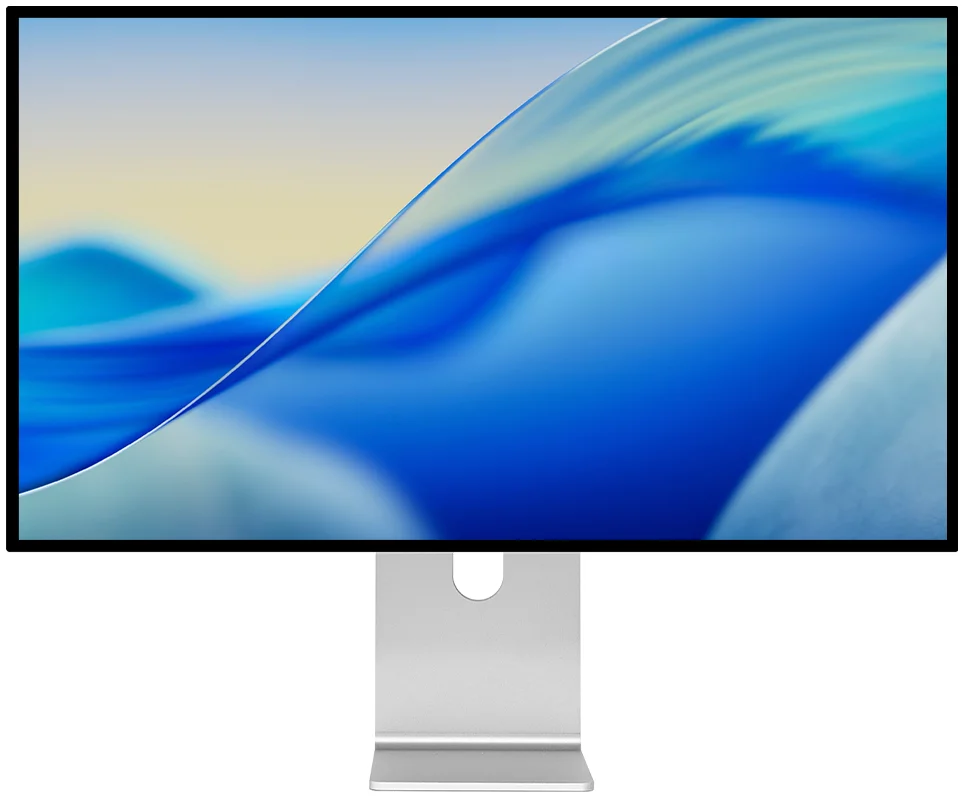
Kuycon G32P
32" · 6K · 223 ppi
From €1,329.00 incl. VAT
- Resolution6144 × 3456
- Density223 ppi
- PanelNano IPS Black
- Contrast2000:1
- Brightness500 nits
- FinishGlossy glass
Why it is here: it is the only 32-inch 6K glossy screen on the market since the Pro Display XDR was discontinued. It even shows slightly more pixels than the XDR — 21.2 million against 20.4 — on a Nano IPS Black panel whose deep blacks a matte film would ruin.
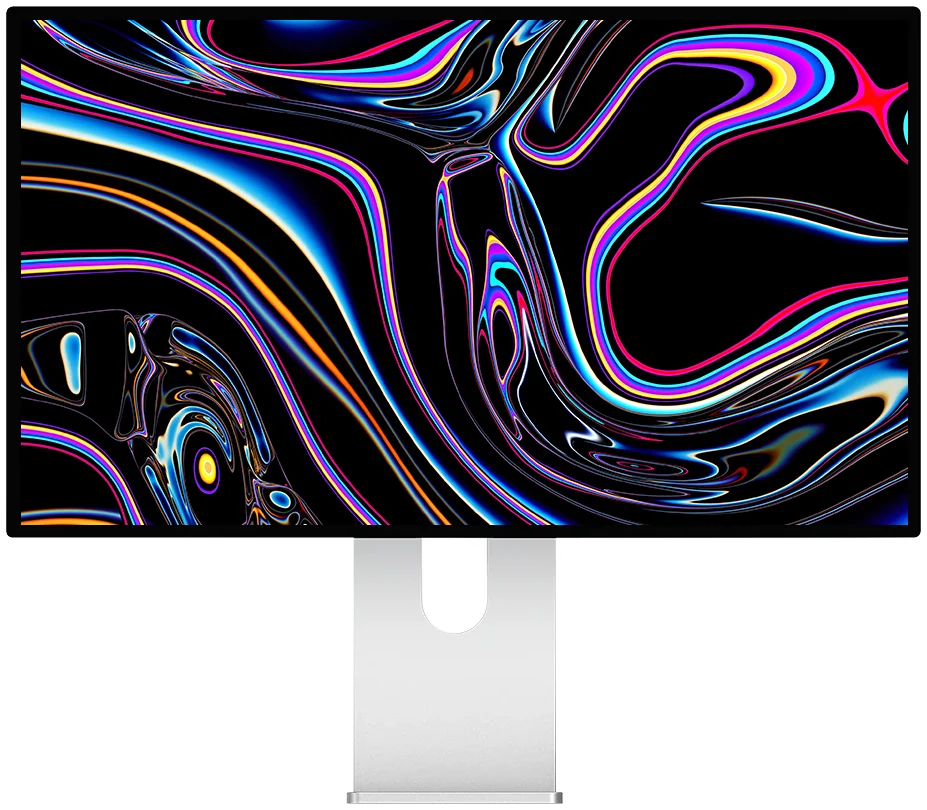
Kuycon G27P
27" · 5K · 218 ppi
From €939.00 incl. VAT
- Resolution5120 × 2880
- Density218 ppi
- PanelIPS Black
- Contrast2000:1
- Brightness600 nits
- FinishGlossy glass
Why it is here: the same diagonal, the same resolution, the same density and the same glossy finish as Apple’s 27-inch display, with 2000:1 contrast instead of 1000:1. Sitting next to a MacBook, it gives the same picture, without the veil.
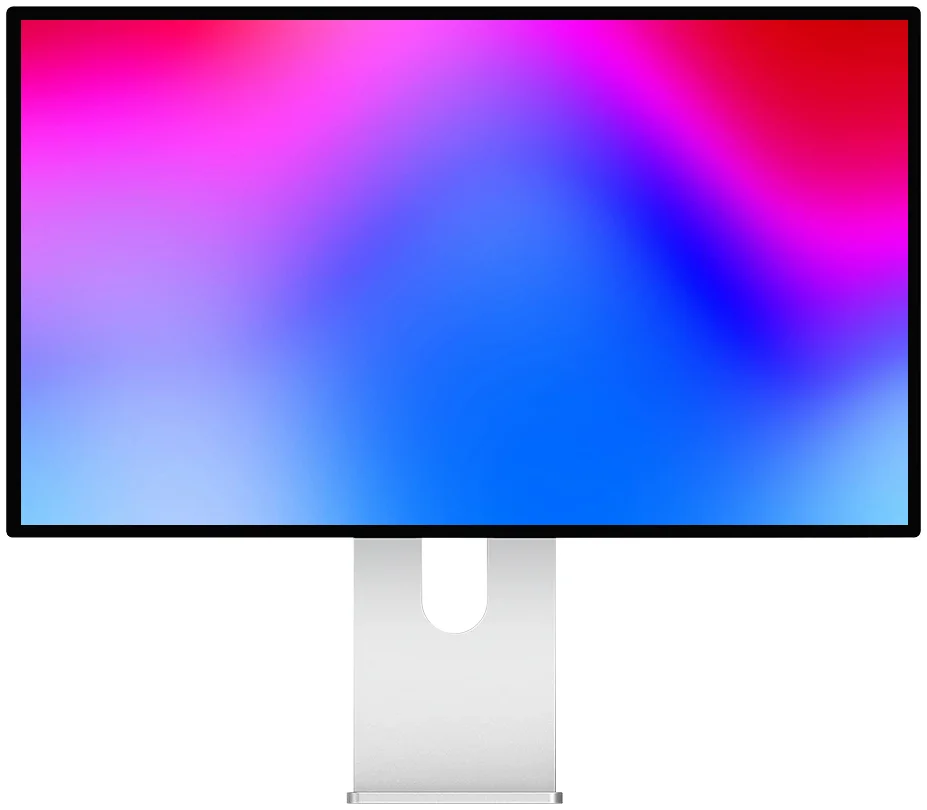
Kuycon P27Z
27" · 5K · up to 330 Hz
From €1,069.00 incl. VAT
- Resolution5120 × 2880
- Density218 ppi
- Refresh rate180 Hz at 5K
- Esport mode330 Hz at QHD
- Brightness600 nits
- FinishGlossy glass
Why it is here: it takes the silhouette of the Pro Display XDR — machined aluminium chassis, slotted stand, edge-to-edge glass front — on the diagonal of the Studio Display. And it does what neither of them can: 5K at 180 Hz, or QHD at 330 Hz.
Prices are shown in your currency. Aluminium chassis, 100 × 100 VESA adapter and cables included; adjustable stand optional on these three models.
Honestly
When matte is still the right choice
Glossy glass has a downside, and we are not going to pretend otherwise: a light source placed behind you reflects clearly. A south-facing window at your back, an unshaded lamp, a lit white wall — in those conditions a matte panel is more comfortable, and no anti-reflective treatment changes that.
That is why we also sell matte screens. The G32X matches the exact resolution of the Pro Display XDR at 32 inches, the P27L covers 27-inch 4K, and the P40K and the P40U cover 40 inches. Choosing a finish is not choosing a tier: it is choosing for a room.
The rule is simple. Look at what is behind you when you are sitting at your desk. If it is a dark wall, a bookcase or a room lit from the side, go glossy: you gain contrast and sharpness. If it is a patio door, go matte, or move the desk.
The detail of both treatments, with measurements, is in our guide matte or glossy. And if density interests you more than surface area, see what Retina really means.
FAQ
Glossy screens: frequently asked questions
Why are almost all monitors matte?
Because a matte film costs a few cents, is applied in series and avoids returns caused by reflections in offices lit by strip lights. It is a production and after-sales decision, not a picture-quality one.
Does glossy really improve the picture?
Yes, on three measurable points: blacks stay deep instead of turning grey, text is not softened by a diffusing layer, and colours keep their saturation. The denser and more contrasted the panel, the more visible the difference.
Does the anti-reflective treatment remove reflections?
No, it reduces them strongly. A reflection stays sharp, but far less bright than on bare glass. If nothing lit sits behind you, you will not see any.
Which Kuycon screens are glossy?
The G32P, the G27P, the G27X SE, the P27Z, the P27D, the P32K and the Q32S. The G32X, the P27L, the P40K and the P40U are matte. The exact finish is listed on each product page.
Is it the same finish as on an Apple display?
The principle is identical: a glass front with an anti-reflective treatment, not a diffusing film. Apple offers nano-texture glass as a paid extra, which is its version of matte; our matte models use a conventional treatment.
How do you clean a glossy glass screen?
A clean microfibre cloth, dry or lightly dampened with water, screen switched off. No alcohol, no window cleaner, no paper towel: the anti-reflective treatment is a coating applied to the surface, and it does wear away.
Glass, where it counts
Three high-density screens, in anti-reflective glossy glass with an aluminium chassis. Two-year warranty, after-sales service in Europe.
See the rangeGuide written in September 2026. Prices are shown in your currency and may change; check the product page.